
Living in Zambia for ministry is hard. Not only do you have electricity issues (the government regulates when your community’s power is on), but you also have water problems. The government also determines when to send water into your area. But one of the most challenging things for ministry, though, is the literacy rate.

When we moved to Zambia, we came armed with boxes of books that we sent over on a shipping container. We also came with a membership to our local Florida library which gave us access to a whole digital library. There are no public libraries in Zambia and very few bookstores. The stores contain a large section of schoolbooks and school supplies, with very little attention to actual books.
Many people within Lusaka, the capital city of Zambia, do not have a full education – through grade 12. It is more common for adults to have a grade 7 or grade 9 education. Due to national exams at those levels, pupils who do not pass do not continue with their education. Some are able to take those exams again, but many do not have the ability to study and pass them. This means that many of the adults in Lusaka do not have formal teaching after grade 7 or 9. They do not have a full grasp on reading English either. Zambia is known to be an illiterate society. I have even heard this common Zambian adage: If you want to hide something from a Zambian, put it in a book.
Knowing this is why a special Thursday blew me away and had me in tears.
My daughter Hannah and I love Thursdays during Camp Life. That is the day that we drive into the communities around Lusaka and have Family Day. Each Camper (child) invites a guardian to attend a mini-Camp Life session at a partner church in their area. All the American ambassadors drive to the Family Legacy School in that community for a small tour. Then they walk to the church where the kids are. We love seeing the different Family Legacy Schools.
But wearing my chitenge (African fabric tied around your waist) and walking through the dusty roads of Lusaka, hand in hand with street children warms my heart. I love seeing their smiles, hearing their giggles, and keeping up the pace of their shoeless feet as we jump over puddles, dodge chickens or goats, duck under drying laundry, and wind through the labyrinth of houses to the church. My special tour guides find joy in leading this M’zungu through their hometown.


One special Thursday in the community of Chiasa touched my soul. I had a God appointment outside the church where the Camp Life session was going on. As always, I found a young mother with a baby and stole that sweet one as I chatted with her mum. She told me that her nephew was in Camp Life so she came to check it out. We chatted about her family and her community. She was surprised to hear that I spoke a little Nyanja.
We sat down on a cement drainage next to two older Zambian women and engaged in conversation with them. They were members of the church we were seated outside of and came to see what was happening. After several minutes of chatter, I looked down and saw that the older woman right next to me had book in her bag that looked like a Bible. I asked about it, pointing to where I saw it. She gladly retrieved it which is where the God story and goosebumps started.

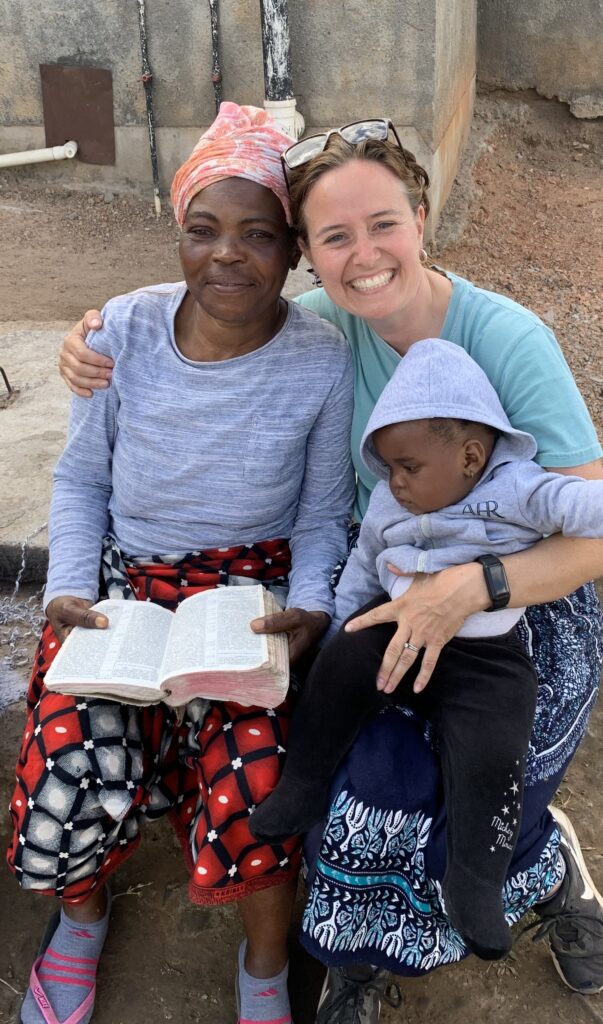
This sweet woman pulled out of her bag a black Bible with a tattered cover and smooth white pages. The corners were bent from years of careful handling. As I looked more closely at the cover, I noticed that it wasn’t in English but written in Chichewa (a language similar to the Nyanja that we minister in). A Chichewa Bible? I had never seen one before. Could she really read it? I asked her about it, and she began telling me all about this prized possession. She was an educated woman and knew several Zambian languages as well as English.
I asked her to show me John 3:16. She quickly turned the pages and eloquently read the familiar passage to me. It is one that I have heard maybe even a thousand times, but hearing it in Chichewa brought tears to my eyes. It was powerful. We know many words and phrases in this language, but I had never heard it read so beautifully in this way.
We went back and forth. She read a verse in Chichewa and I recited it in English. When I didn’t remember the verse, she would translate it into English the best that she could. Special. Powerful. A God moment. As tears streamed down my face, I asked her if I could take a video or two of her reading. I wanted to always remember this moment… a special joy I felt upon hearing the Scriptures.
Share in my joy by watching this short video:
PS… this encounter lit a fire in me to get a Chichewa Bible for myself. I want to memorize verses in Chichewa as well. This whole experience has brought me so much Joy in the Scriptures!
If you want to hear more about our adventures and ministry in Zambia, visit our ministry website HERE or more on this blog HERE. To find out more about becoming a Biblically Minded Family, check out THIS ARTICLE.

Leave a Reply